
Services
Wire rope installation
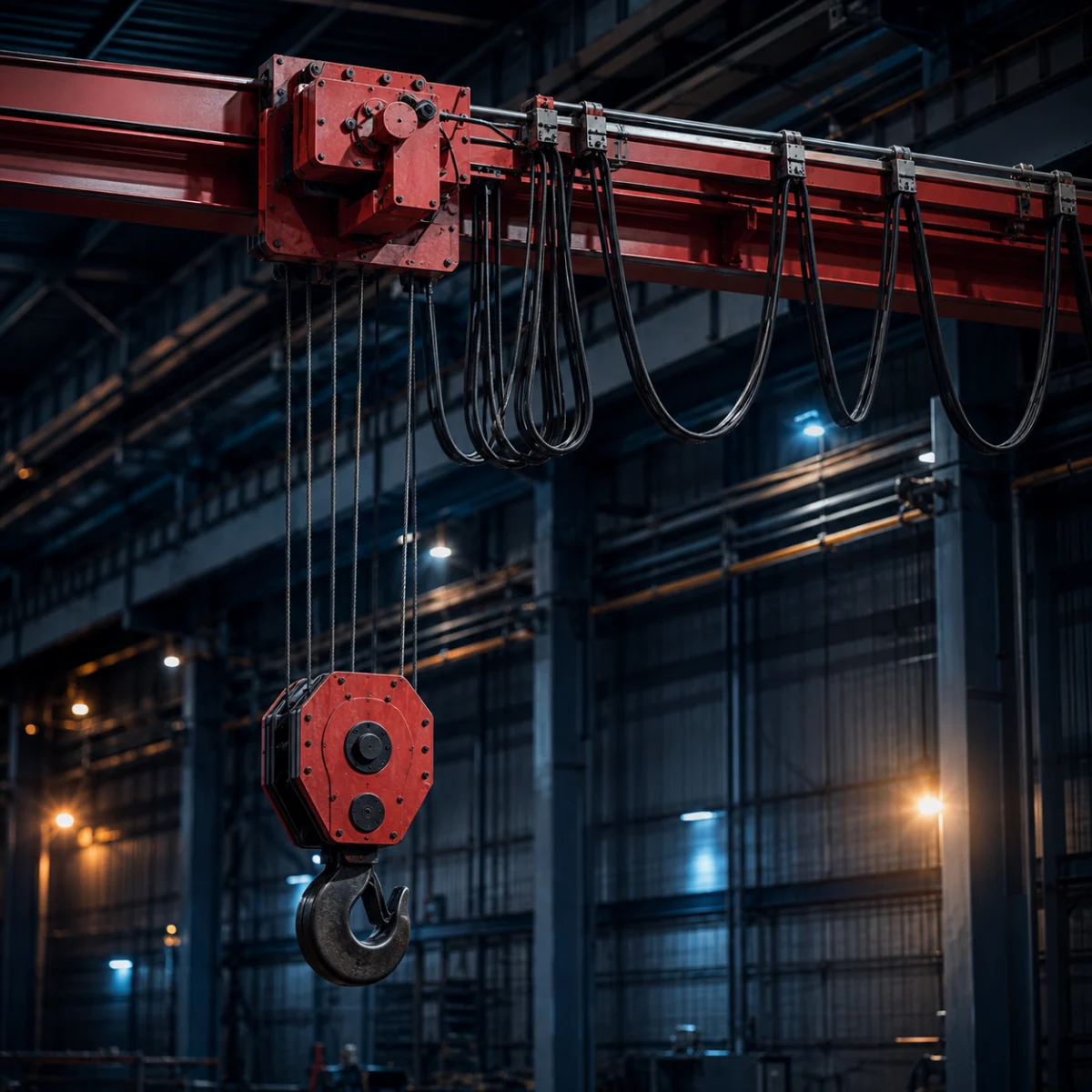
Supply, reeving and tensioning of wire rope on cranes and lifting equipment, carried out on site so the machine returns to service without a second mobilisation.
A wire rope is not a length of cable with a price per metre. Construction, lay direction, core type and termination all follow from the machine and the duty, and a rope that looks correct on paper can still be wrong for the drum it has to spool onto.
We supply the rope and install it on site, so the equipment goes back to work without being moved for the work. That covers reeving through the sheaves and the hook block, tensioning and seating the new rope, and the terminations and fittings that suit the duty rather than whatever happened to be fitted last time.
Where a rope is being changed because something failed, the failure is worth reading before the new one goes on. A rope that wore on one side has been telling you something about the sheave or the alignment, and fitting an identical replacement without looking simply repeats the fault.
What this covers
- Supply of wire rope matched to the machine and the duty
- Reeving through sheaves, drum and hook block
- Tensioning and seating of the new rope
- Terminations, sockets, thimbles, clamps and end fittings
- Carried out on site, so the equipment stays where it works
- A look at the rope that came off, where the reason for the change matters
What shapes this work
The drum decides more than the catalogue does
Lay direction has to suit the way the rope spools, or the new rope fights the drum from the first lift. This is one of the details that costs nothing to get right at order and a great deal to discover afterwards.
Terminations are part of the specification
A rope assembly is only as good as its end fitting, and the fitting has to match both the rope and the anchorage. Supplied as an afterthought it becomes the weak point of the whole arrangement.
Wear patterns are evidence
Even wear along the rope is a rope at the end of its life. Wear on one side, or concentrated in one place, is usually the machine rather than the rope, and that is worth knowing before the replacement is fitted.
Questions buyers ask about this
Do you work on site, or does the equipment come to you?
On site. That is the point of the service: moving a crane so that a rope can be changed costs more than the rope.
Do you supply the rope as well as fit it?
Both, quoted together, with the terminations and fittings included rather than discovered as a separate line afterwards.
What do you need in order to quote a rope change?
The machine, the diameter and construction of the existing rope if you have them, and what the equipment lifts. A photograph of the nameplate and of the rope on the drum usually answers most of it.
The other services we offer
Industrial procurement
End to end supply chain solutions for spare parts and equipment, sourced against your specification rather than against a description.
Read moreSpark arrestors
High grade steel spark arrestors for diesel engines operating in hazardous area classifications.
Read moreRugged industrial smartphones
Intrinsically safe rugged smartphones and tablets for teams working inside classified hazardous areas.
Read moreTower and EOT crane services
Erection and dismantling of tower cranes, plus supply of EOT crane parts and accessories.
Read moreTechnical support
Specification assistance before you order and responsive support after delivery.
Read more